







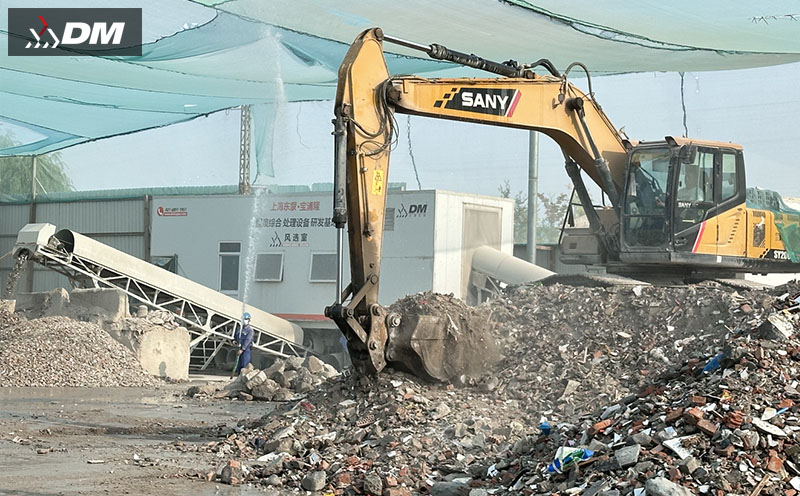
From massive construction waste generated by urban demolition, bulk industrial residue from production, to waste household appliances left by the upgrading of electronic devices, and tailings piled up from mining activities, global waste output is growing at an annual rate of 8%. The traditional disposal methods of "landfilling + incineration" not only waste resources but also trigger severe environmental problems such as soil pollution and greenhouse gas emissions. Against this backdrop, the "circular economy" has become the core path for global sustainable development, and efficient, intelligent, and high-value recycling technologies are the key to realizing "turning waste into treasure." With years of technological accumulation and engineering practice, China has built a recycling technology system covering "full-category waste recycling, full-chain resource utilization, and full-scenario environmental adaptation." Supported by core technologies such as construction waste resource utilization, industrial residue recycling, electronic waste dismantling, and tailings recovery, it transforms waste into recyclable valuable resources, providing a "Chinese solution" for the development of the global circular economy.
Core Advantages: Five Technological Highlights Unlocking Waste Value
Chinese recycling technology is not a breakthrough of a single equipment or process, but a systematic innovation integrating materials science, intelligent control, environmental engineering, and other fields. It addresses the pain points of traditional recycling such as "category limitations, low efficiency, low added value, and serious pollution" from five dimensions: recycling scope, utilization efficiency, product value, environmental standards, and scenario adaptation.
1. Full-Category Waste Coverage: One System Adapts to All-Scenario Waste
Breaking the limitation of traditional recycling technology's "single-category adaptation," realizing efficient treatment of multiple types of waste: ① Bulk solid waste: For construction waste (concrete, bricks, steel bars), industrial residue (steel slag, coal gangue, fly ash), mine tailings (granite tailings, metal mine tailings), etc., the resource recovery rate reaches over 95% through "classified crushing + precise sorting" technology; ② Electronic waste: Innovating "low-temperature dismantling + precious metal purification" technology, it can efficiently process waste mobile phones, computers, household appliances, etc., achieving a recovery rate of ≥99% for precious metals such as gold, silver, and copper, and a recycling rate of 92% for plastic, metal, and other components; ③ Special waste: For hazardous waste such as medical waste and waste batteries, an integrated scheme of "high-temperature sterilization + harmless treatment + resource recovery" is adopted to achieve zero leakage of harmful substances and a resource conversion rate of 85%. In an electronic waste treatment project, China's recycling system processes 500 waste household appliances daily, extracting 2.3kg of gold, 15kg of silver, and 3.2 tons of copper, creating an annual output value of over 120 million yuan, with an efficiency 60% higher than traditional dismantling technology.
2. High-Value Resource Utilization: Leap from "Waste" to "High-Quality Resources"
Subverting the dilemma of traditional recycling's "low-end products and limited applications," realizing high-value conversion of waste: ① Construction waste recycling: Through "multi-stage crushing + shaping strengthening + intelligent impurity removal" technology, the produced recycled aggregates have a compressive strength of C80 grade, which can be used in high-grade concrete, precast components, and road bases, reducing costs by 40% compared to natural aggregates; derived products include recycled permeable bricks, recycled mortar, recycled concrete precast components, etc., with added value 3-5 times higher than ordinary recycled aggregates; ② Industrial residue recycling: After "water quenching modification + magnetic separation purification" treatment, steel slag can be made into high-quality steel slag powder (for cement admixture), road base materials, and even high-end wear-resistant materials, with utilization rate increased from 30% traditionally to 98%; fly ash is converted into high-performance concrete admixture and thermal insulation materials through "classified sorting + activation modification" technology, with an annual absorption capacity of over 500 million tons; ③ High-value recycling of electronic waste: Adopting a combined process of "precision dismantling + chemical purification + physical sorting," the purity of extracted precious metals reaches 99.99%, and recycled plastics can be used in high-end scenarios such as electronic component casings and auto parts after modification. In a steel slag recycling project, Chinese technology converts 1.2 million tons of annual steel slag emissions into 800,000 tons of steel slag powder and 300,000 tons of road aggregates, creating an annual economic benefit of over 300 million yuan and reducing iron ore mining by 600,000 tons.
3. Intelligent and Efficient Processing: Full-Process Digital Management for Efficiency and Cost Reduction
Integrating Industry 4.0 technologies to realize intelligent and efficient operation of the recycling process: ① Intelligent sorting system: Integrating multi-dimensional technologies such as AI visual recognition, electromagnetic sorting, air sorting, and density sorting, it can automatically identify waste of different materials, particle sizes, with a sorting accuracy of 99.5%, 30 times higher than manual sorting efficiency; ② Digital production management and control: Equipped with a PLC central control system and industrial Internet of Things platform, it real-time monitors parameters of crushing, sorting, purification and other links, automatically adjusts process parameters to ensure stable product quality, and improves production efficiency by 40%; ③ Remote operation and maintenance support: Supporting real-time monitoring of equipment status and production data via computer and mobile terminals, more than 85% of common faults can be resolved through remote diagnosis, with the equipment's mean time between failures (MTBF) exceeding 18,000 hours. After an urban construction waste resource utilization factory adopted China's intelligent recycling system, the daily processing capacity of a single factory increased from 800 tons to 1,500 tons, labor costs were reduced by 70%, and the product qualification rate remained above 99%.
4. Full-Range Environmental Compliance: Pollution-Free Recycling Protects the Ecological Environment
Strictly following international environmental standards, building a "full-process pollution-free" recycling system: ① Waste gas treatment: The crushing, dismantling, and purification links adopt "sealed collection + activated carbon adsorption + catalytic combustion" technology, with the emission concentration of harmful gases (VOCs, dioxins) ≤0.1mg/m³, far lower than the EU standard (≤0.5mg/m³); ② Wastewater treatment: A closed-loop water circulation system is used for equipment cooling and aggregate cleaning. Wastewater is 100% recycled after "sedimentation + filtration + reverse osmosis" treatment, with a daily water consumption ≤0.2m³/ton, realizing zero discharge; ③ Solid waste disposal: A small amount of non-recyclable residue generated during the recycling process can be used for brick-making and subgrade filling after harmless treatment, realizing "full absorption of waste." Through China's environmental protection recycling technology, a construction waste resource utilization project has a dust emission concentration ≤2mg/m³ and noise ≤62dB(A), becoming a local "zero-waste factory" demonstration project, with air quality around the factory better than the urban average.
5. Multi-Scenario Flexible Adaptation: Global Coverage from Cities to Villages
Providing customized solutions for recycling needs of different regions and scales: ① Large-scale centralized treatment: Modular fixed recycling plants with a daily processing capacity of up to 5,000 tons, adapting to scenarios with concentrated bulk waste such as cities and industrial zones; ② Small and medium-sized decentralized treatment: Mobile recycling stations (tracked, wheeled) can directly reach demolition sites, mining areas, and villages, with a daily processing capacity of 300-1,000 tons, no infrastructure investment required, and operation can start immediately after landing; ③ Extreme environment adaptation: Plateau-type recycling equipment can operate stably at an altitude of 4,500m, low-temperature equipment adapts to harsh environments of -30℃, and water resource utilization rate of equipment in arid areas is increased by 80%. In a rural construction waste recycling project in Tibet, the mobile recycling station is powered by a diesel generator in a scenario with an altitude of 3,800m and no grid coverage, processing 350 tons of construction waste daily, producing 280 tons of recycled aggregates for rural highway construction, saving 90% of natural aggregate transportation costs.
Technical Core: Four Key Technologies Supporting the Upgrade of the Circular System
The core competitiveness of Chinese recycling technology stems from full-chain technological innovation, and four key technologies build industry barriers:
1. Intelligent Precision Sorting Technology: Core Guarantee of Recycling Efficiency
Integrating "AI visual recognition + multi-dimensional physical sorting" technology: The AI visual module can quickly identify the material, shape, and particle size of waste with an accuracy of 99.8%; the electromagnetic sorting module separates metal impurities with a recovery rate ≥99%; the air sorting module separates lightweight plastics and wood chips with a sorting accuracy of 99%; the density sorting module separates minerals and aggregates of different densities, ensuring the purity of recycled products and laying the foundation for high-value utilization.
2. Recycling Strengthening and Modification Technology: Key to Improving Product Value
Adopting customized strengthening technologies for different waste characteristics: Construction waste recycled aggregates have their compressive strength and wear resistance increased by 50% through "surface activation + particle shaping" treatment; industrial residues are converted into high-performance building materials and functional materials through "high-temperature modification + composition adjustment"; plastics in electronic waste meet the standards of virgin plastics in mechanical properties through "chemical modification + particle reshaping," and can be used in high-end manufacturing scenarios.
3. Closed-Loop Environmental Treatment Technology: Core Support for Pollution-Free Recycling
Building a full-process environmental treatment system for "waste gas, wastewater, and solid waste": Waste gas adopts "source sealing + multi-stage purification" technology to ensure compliance with harmful gas emissions; wastewater realizes zero discharge through a closed-loop circulation system; non-recyclable solid waste is reused after harmless treatment, realizing a closed-loop cycle of "waste - resources - products - recycled resources" with no discharge of any pollutants.
4. Modular Integration Technology: Foundation for Multi-Scenario Adaptation
Adopting standardized and modular design, which can be flexibly combined according to waste type, processing scale, and application scenario: Crushing, sorting, purification, environmental protection and other modules are combined through quick-connect interfaces, supporting phased construction and expansion and upgrading; mobile recycling equipment integrates power, processing, and storage modules, which can adapt to decentralized and remote area operation needs, greatly reducing initial investment and operation and maintenance costs.
Typical Application Cases: Global Implementation, Witnessing Circular Value
Chinese recycling technology has been applied in multiple projects at home and abroad, winning wide recognition for its high recovery rate, high added value, and high environmental standards:
Case 1: Beijing Construction Waste Resource Utilization Demonstration Project
Project Demand: Treating urban demolition construction waste (annual output over 5 million tons), producing high-grade recycled aggregates, recycled permeable bricks and other products, requiring environmental compliance and resource utilization rate ≥95%. China's Solution: Intelligent modular construction waste recycling system (multi-stage crushing + shaping + intelligent sorting + environmental protection treatment). Application Effects: ① Annual treatment of 5.2 million tons of construction waste, producing 4.16 million tons of recycled aggregates and 320 million recycled permeable bricks, with a comprehensive resource utilization rate of 98%; ② Recycled aggregates are used in the construction of Beijing Urban Sub-center's subway and roads, replacing natural aggregates to save 180 million yuan in mining costs and reduce landfilling by 800 mu; ③ Dust emission ≤2mg/m³, noise ≤62dB(A), passing the national "zero-waste factory" certification, becoming a national benchmark for construction waste resource utilization.
Case 2: Southeast Asia Electronic Waste Recycling Cooperation Project
Project Pain Points: The local annual electronic waste output exceeds 200,000 tons. Traditional dismantling technology has low efficiency and serious pollution, with a precious metal recovery rate of less than 60%. China's Solution: Low-temperature precision dismantling + precious metal purification and recycling system. Application Effects: ① Daily processing of 600 tons of electronic waste, with a precious metal (gold, silver, copper) recovery rate of 99.2%, extracting 500kg of gold, 3 tons of silver, and 800 tons of copper annually, creating an output value of over 200 million US dollars; ② Adopting environmental protection dismantling process, with dioxin emission concentration ≤0.05mg/m³, far lower than local standards, and 100% recycling of wastewater; ③ Training more than 300 local technical personnel, building a localized recycling system of "technology + equipment + services," helping local circular economy development.
Case 3: Northwest Mine Tailing Recycling Project
Project Demand: Treating iron ore tailings (annual accumulation over 8 million tons) in a mine, solving the problems of land occupation and water pollution by tailings, and realizing resource reuse. China's Solution: Integrated tailing sorting + recycled aggregate production system. Application Effects: ① Annual treatment of 7.8 million tons of tailings, producing 1.2 million tons of iron concentrate (grade ≥65%) and 6 million tons of construction aggregates, with a tailing utilization rate of 95%; ② Iron concentrate is returned to the smelter, and recycled aggregates are used in the construction of surrounding expressways, creating an annual economic benefit of 450 million yuan; ③ Restoring 1,200 mu of vegetation in the tailing accumulation area, improving the regional ecological environment, and passing the "Green Mine" certification.
Circular Future: Chinese Technology Empowers Global Sustainable Development
Waste is a "resource in the wrong place," and recycling technology is the key bridge connecting resources and circulation. Centered on "turning waste into treasure," Chinese recycling technology not only solves the environmental problem of waste disposal but also creates enormous economic and social value, providing an effective path for the global realization of "carbon peaking and carbon neutrality" goals. From the resource utilization of urban construction waste, high-value conversion of industrial residue, to the green dismantling of electronic waste, Chinese technology is deeply integrated into the global circular economy system, promoting the upgrading of the global recycling industry through technology transfer, project cooperation, and talent training.
In the future, China will continue to deepen the innovation of recycling technology, integrate cutting-edge technologies such as artificial intelligence, new energy, and the Internet of Things, and further improve recycling efficiency and product added value; focus on the waste characteristics and development needs of different regions around the world, provide more customized solutions; expand the localized service network, build a full-chain cooperation system of "technology R&D + equipment manufacturing + project operation + talent training," allowing Chinese recycling technology to benefit more countries and regions, and work with global partners to build a "resource-circulating, environment-friendly, and economically efficient" circular future, writing a new chapter of sustainable development.
If you would like to get help immediately, you can also fill your requirements on the following form, we will contact you on the right time.


Get In Touch