







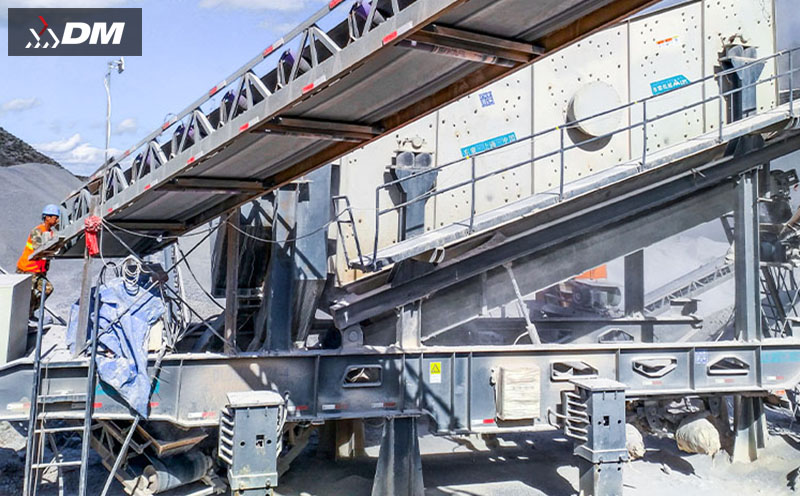
1. Ethiopia's "Cost-Saving Demand": Equipment Dilemma in Infrastructure & Industrial Development
In recent years, Ethiopia has accelerated the implementation of infrastructure projects such as highways, bridges, and residential buildings, while building materials enterprises like sand and gravel yards and concrete mixing plants have also expanded with growing demand. However, "high costs and difficult equipment adaptation" have always restricted industrial development: on one hand, most local infrastructure projects are located in mountainous areas with tight energy supply. Traditional crushers have low crushing ratios, requiring repeated refeeding and re-crushing to produce qualified aggregates, which not only consumes more diesel or electricity (diesel price is about 45 Birr/liter, and industrial electricity prices remain high) but also prolongs the production cycle; on the other hand, building materials enterprises and mining companies often face the problem of "needing multiple equipment for multiple scenarios" — "rock crushers" are required for infrastructure aggregate production, "sand making machines" for building sand production, and special equipment for mining material processing, doubling equipment investment and management costs, which small and medium-sized enterprises can hardly bear. More importantly, the "single-scenario limitation" of traditional equipment makes enterprises frequently face the contradiction of "equipment idleness" or "insufficient capacity" when undertaking different types of projects: a mixing plant purchased two traditional equipment to meet both aggregate and sand production needs, but due to fluctuations in project peaks and valleys, the annual equipment utilization rate was less than 60%, resulting in capital waste. At this point, a crusher with both "high crushing ratio for cost reduction and efficiency improvement" and "flexible multi-scenario adaptability" has become the core choice for Ethiopia to solve the cost dilemma.
2. High Crushing Ratio: From "Repeated Processing" to "One-Time Forming", the Core of Cost Reduction & Efficiency Improvement
With high crushing ratio as its core advantage, this crusher increases the crushing ratio to 16-22, far exceeding the 5-8 of traditional models, realizing "one-time crushing of large raw stones into qualified finished products" and completely eliminating the refeeding process. It compresses costs for Ethiopian enterprises from three aspects: energy consumption, labor, and time.
1. One-Time Forming Saves Energy: Reducing Energy Waste & Lowering Fuel/Electricity Expenses
When traditional equipment processes hard rocks such as basalt and granite over 1000mm, 2-3 times of refeeding and re-crushing are required, and each refeeding consumes additional energy; relying on its high crushing ratio, this crusher can crush hard rock raw stones into 15-30mm infrastructure aggregates in one go, and soft rocks (limestone, marble) into 0-5mm building sand in one go, directly reducing energy consumption by 30%. For a highway project near Addis Ababa, traditional equipment consumed 120 liters of diesel per day for aggregate production; after switching to this crusher, one-time forming reduced daily diesel consumption to only 75 liters. Based on the diesel price of 45 Birr/liter, it saves 18,000 Birr in monthly diesel costs, with a total energy cost savings of over 1 million Birr during the project construction period.
2. Fewer Processes Improve Efficiency: Shortening Production Cycle & Reducing Labor Input
The elimination of the refeeding process simplifies the production process from "crushing-refeeding-re-crushing" to "one-time crushing-finished product", shortening the production cycle by 50%. At the same time, there is no need for dedicated personnel to be responsible for refeeding transportation and secondary operations, reducing labor demand by 1-2 workers per shift. A sand and gravel yard in the Oromia Region previously required 3 workers to take shifts (1 for operating the main machine, 2 for refeeding) with a daily output of 600 tons; after adopting this crusher, only 2 workers are needed to complete production, with the daily output increased to 1000 tons, and labor costs saved by 30,000 Birr per month (based on the local technical worker monthly salary of 15,000 Birr).
3. Multi-Scenario Adaptability: One Equipment Equals Multiple, Saving Investment & Lowering Management Costs
Relying on modular design and intelligent adaptation technology, this crusher can flexibly meet Ethiopia's three core scenarios: infrastructure, building materials, and mining. No additional special equipment needs to be purchased, significantly reducing enterprises' early investment and later management costs.
1. Infrastructure Scenario: Efficient Production of Qualified Aggregates
Targeting the demand for aggregates (5-30mm) in infrastructure projects such as highways, bridges, and hydropower stations, the equipment ensures that hard rocks like basalt and granite have round particle shapes (flakiness content ≤8%) and uniform gradation after crushing through the reinforced crushing chamber design. They can be directly used for concrete mixing without additional shaping, meeting the requirements of high-grade concrete. After a hydropower station project used this equipment, the aggregate qualification rate increased from 75% (traditional equipment) to 96%, avoiding rework caused by aggregate quality issues and saving 200,000 Birr in rework costs.
2. Building Materials Scenario: Flexible Switch Between "Aggregate/Sand Making" Modes
Equipped with a detachable impact sand making module, it only takes 30 minutes to switch between "aggregate production" and "building sand production" modes: when the module is installed, stones can be crushed into 0-5mm high-quality sand in one go, with a gradation qualification rate of 95%, meeting the demand for building sand in wall masonry and plastering; when the module is removed, it returns to the aggregate production mode. A concrete mixing plant in Dire Dawa previously needed to purchase a crusher (800,000 US dollars) and a sand making machine (600,000 US dollars) separately; after switching to this equipment, a single device (1,000,000 US dollars) can cover both needs, reducing equipment investment by 400,000 US dollars. Moreover, there is no need to manage two devices separately, saving 20,000 Birr in monthly operation and maintenance costs.
3. Mining Scenario: Adapting to Multi-Type Mineral Processing
Targeting different mineral types in Ethiopia such as gold-associated hard rock, marble ore, and limestone ore, the equipment can efficiently process soft rock, hard rock, and mixed ore through intelligent power adjustment (PLC system real-time adaptation to mineral hardness). A gold mine in the Tigray Region used this equipment to process mixed ore of associated granite (hard rock) and limestone (soft rock) without manual sorting, achieving a daily processing capacity of 800 tons, which is 60% higher than the traditional separate-line processing mode, and reducing mineral processing costs by 25%.
4. Practical Cases: Visible Cost Reduction Effects, Empowering Enterprise Development
- Infrastructure Project (Provincial Highway): After a project adopted this crusher, the daily aggregate output increased from 500 tons to 900 tons, and the construction period was advanced by 1.5 months; energy + labor costs were saved by 48,000 Birr per month, and the total project cost was reduced by 18%.
- Building Materials Enterprise (Mixing Plant): After a mixing plant replaced two traditional equipment with this crusher, equipment investment was saved by 400,000 US dollars, annual operation and maintenance costs were saved by 240,000 Birr, and the comprehensive cost was reduced by 22%, significantly improving product competitiveness.
5. Conclusion: Solving Ethiopia's Cost Reduction Dilemma with "High Crushing Ratio + Multi-Scenario Adaptability"
At the critical stage when Ethiopia pursues infrastructure acceleration and industrial cost reduction, this crusher accurately solves the pain points of local enterprises such as "high energy consumption, multiple equipment, and high costs" with the dual advantages of "one-time forming with high crushing ratio" and "flexible multi-scenario adaptability" — it not only reduces energy and labor waste but also lowers equipment investment and management costs, allowing infrastructure projects to "be built quickly without exceeding the budget" and enabling enterprises to "produce more and be more profitable". In the future, as more Ethiopian enterprises adopt this equipment, it will surely promote the improvement of local infrastructure efficiency and industrial cost optimization, injecting strong momentum of "cost reduction and efficiency improvement" into economic development.
If you would like to get help immediately, you can also fill your requirements on the following form, we will contact you on the right time.


Get In Touch