







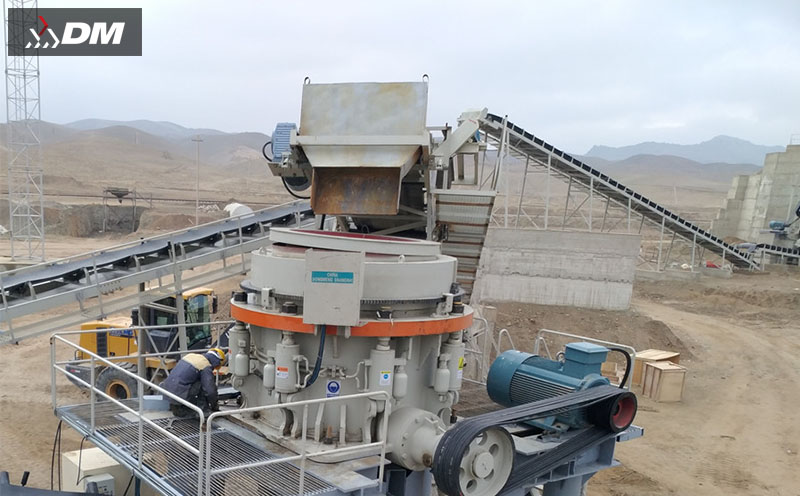
As a core market for mining and infrastructure development in East Africa, Ethiopia is endowed with abundant mineral resources such as gold, limestone, basalt, and marble. Meanwhile, large-scale infrastructure projects including roads, bridges, and housing are advancing continuously, bringing broad development opportunities for mines and quarries. However, most local mines and quarries still rely on outdated crushing equipment, facing pain points such as "backward technology, high energy consumption, cumbersome operation and maintenance, and uncontrolled costs," which makes it difficult to meet the dual market demands for production capacity and efficiency. The Ethiopia-specific crushers, tailored with advanced European crushing technology, are centered on "high performance, low energy consumption, easy maintenance, and strong adaptability." By deeply integrating European precision manufacturing processes with local working conditions in Ethiopia, they significantly reduce operating costs while ensuring production efficiency, becoming a core equipment to help local enterprises modernize their sites and seize market opportunities.
I. Core Pain Points of Site Operations in Ethiopia: Four Major Bottlenecks Restricting Development
Most of Ethiopia's mines and quarries are located in plateau and mountainous areas, characterized by unstable power supply, complex geological conditions, inconvenient spare parts transportation, and limited labor skills. The poor adaptability of traditional crushing equipment leads to low operational efficiency and high costs.
Pain Point 1: Backward Technology, Low Capacity and Poor Quality. Traditional crushers adopt outdated structural designs with low crushing efficiency, processing capacity of only 40-60t/h. When dealing with high-hardness basalt (hardness up to 180-260MPa) commonly found in Ethiopia, they are prone to material jamming and overload, with actual capacity only 55%-65% of the designed value. The finished material has uneven particle size and excessive needle-like content, with a qualification rate of less than 70%, making it difficult to meet the demand for high-quality aggregates in infrastructure projects and resulting in weak product premium capacity.
Pain Point 2: High Energy Consumption, Burdened Operating Costs. Local outdated diesel crushers consume over 35L of fuel per hour, with a unit material crushing energy consumption of 15-18kWh/t. Coupled with fluctuations in diesel prices, fuel costs account for more than 40% of operating costs. Some equipment relying on grid power lacks energy-saving designs, and frequent voltage fluctuations in the power grid further increase energy consumption and downtime losses.
Pain Point 3: Difficult Operation and Maintenance, Severe Downtime Losses. Traditional equipment's wearing parts are made of poor-quality materials, with liners and hammers having a service life of only 80-120 hours, requiring frequent replacement. Key spare parts rely on imports with a transportation cycle of 2-3 months, and the capacity loss during downtime waiting for parts can reach tens of thousands of US dollars. Meanwhile, the equipment has a complex structure, and maintenance requires professional technicians, but local technical talents are scarce, leading to extremely low efficiency in fault diagnosis and repair.
Pain Point 4: Poor Adaptability, Constrained by Environment and Site. The Ethiopian plateau has large day-night temperature differences (-5℃-35℃). Traditional equipment lacks temperature-adaptive design and has poor sealing performance, making it prone to component failures due to temperature differences. Some sites have narrow terrain and rough roads, making it difficult to transfer fixed crushing plants, while mobile crushing equipment suffers from insufficient stability, making it difficult to flexibly respond to the needs of different operating areas.
II. Empowered by European Technology: Four Core Advantages of Ethiopia-Specific Crushers
These specialized crushers deeply integrate top-tier European crushing technologies from Germany, Italy, etc., and are locally optimized for Ethiopia's site conditions, resource characteristics, and operational needs. With a processing capacity ranging from 70-400t/h and a maximum feed size of ≤750mm, they are suitable for crushing gold, limestone, basalt, and other minerals, achieving a perfect balance of "European technical standards + local operating costs" and comprehensively addressing site operation pain points.
(I) European Precision Craftsmanship: High-Efficiency Crushing + High-Quality Finished Products
The equipment adopts an "optimized crushing cavity" and "high-energy transmission system" designed by European original manufacturers. The crushing cavity features an involute design, deepened by 15% for smoother material feeding. Combined with a variable frequency speed-regulating motor (power 85-320kw), it can accurately adapt to high-hardness rocks (180-260MPa), with a processing capacity 40%-60% higher than traditional equipment and an actual capacity utilization rate of over 90%. Equipped with a European-standard classification and screening system, the finished material has uniform particle size, with needle-like content ≤8% and a qualification rate of over 95%, which can be directly supplied to high-end infrastructure projects. The product price is increased by 10%-15%, significantly enhancing market competitiveness.
(II) Energy-Saving Technology Innovation: 30% Direct Reduction in Operating Costs
Relying on European energy-saving technologies, the equipment achieves multiple energy consumption optimizations: it adopts a high-efficiency permanent magnet synchronous motor, which is 20%-25% more energy-efficient than traditional motors, with a unit material crushing energy consumption as low as 8-11kWh/t; the diesel-driven version is equipped with a low-fuel-consumption engine (Perkins/Volvo) meeting European emission standards, consuming only 16-22L of fuel per hour, saving more than 30% in fuel costs compared to traditional equipment; meanwhile, it is equipped with an intelligent energy consumption monitoring and optimization system that can dynamically adjust power according to load to avoid ineffective energy consumption. Calculations show that a single equipment can save over 120,000 US dollars in energy and fuel costs annually.
(III) Wear-Resistant and Easy to Maintain: 80% Reduction in Downtime
Wearing parts are made of imported European high-chromium alloy materials, treated with special heat treatment processes, extending the service life of liners and hammers to 350-500 hours—3-4 times longer than traditional equipment—greatly reducing replacement frequency. The equipment adopts a modular design, with standardized and easy-to-disassemble key components. Ordinary workers can replace wearing parts after simple training, and the replacement time is shortened to 1-2 hours. Meanwhile, in cooperation with local service providers, a spare parts warehouse center has been established with sufficient inventory of core spare parts, enabling fast delivery within 72 hours and completely solving the problem of "downtime waiting for parts." In addition, the equipment is equipped with an original European intelligent diagnosis system that can real-time monitor the equipment's operating status and provide early fault warnings, reducing unplanned downtime by 80%.
(IV) Localized Adaptive Design: Compatible with All Environments and Sites
Targeting Ethiopia's environmental and site characteristics, the equipment has been specially optimized: it adopts European IP67-level sealing technology and a temperature-adaptive heat dissipation system, enabling stable operation in a temperature difference environment of -5℃-35℃ and avoiding component failure due to temperature changes; the tracked mobile version is equipped with a European reinforced crawler chassis with low ground pressure and a climbing capacity of 30°, which can easily handle rough mountainous areas and narrow sites. It can be transferred without disassembly and deployed within 1 hour; the fixed version adopts a modular splicing design for easy installation, adapting to the space requirements of different sites, achieving the dual choice of "mobile flexibility + fixed stability."
III. Field-Verified: Successful Cases of Site Modernization in Ethiopia
These European technology-empowered crushers have been widely applied in multiple mines and quarries in Ethiopia, achieving remarkable results in site modernization.
Case 1: A gold mine in northern Ethiopia. Previously using traditional crushers, it had a daily processing capacity of 500 tons, a finished gold ore qualification rate of 68%, and a monthly average operating cost (fuel + spare parts + labor) of 90,000 US dollars. After replacing with specialized crushers, the daily processing capacity increased to 900 tons, the qualification rate reached 96%, and the monthly average operating cost dropped to 63,000 US dollars. The monthly net profit increased by 120,000 US dollars, with an investment payback period of only 7 months.
Case 2: A basalt quarry near Addis Ababa. The original equipment had an average monthly downtime of 5-7 days due to high energy consumption and shortage of spare parts, with a monthly net profit of less than 80,000 US dollars. After adopting specialized crushers, fuel costs were reduced by 35%, the spare parts delivery cycle was shortened to 3 days, the monthly downtime was reduced to less than 1 day, the monthly processing capacity increased to 28,000 tons, and the monthly net profit reached 250,000 US dollars. It successfully won aggregate supply contracts for multiple large-scale infrastructure projects.
IV. Conclusion: Modernize Your Site with European Technology, Win the Future with Low Operating Costs
In the period of rapid development of Ethiopia's mining and infrastructure market, the core of site modernization lies in "technology empowerment + cost control." The specialized crushers integrating advanced European technology and localized adaptive design not only solve the problems of backward technology and low efficiency of traditional equipment but also address the dilemmas of high operating costs and inconvenient maintenance of imported high-end equipment. They provide a "cost-effective, highly adaptable, and high-return" modernization solution for Ethiopia's mines and quarries.
In the future, this series of equipment will further deepen localized services, cooperating with European technical teams and local service providers to offer full-process services including equipment installation, operation training, and regular maintenance, ensuring the long-term stable operation of the equipment. Choosing Ethiopia-specific crushers empowered by European technology means choosing high-efficiency capacity, high-quality products, and controllable costs. It will help your site achieve intelligent and efficient modernization, firmly occupy a leading position in the competitive East African market, and win broader development space.
If you would like to get help immediately, you can also fill your requirements on the following form, we will contact you on the right time.


Get In Touch